The Science Behind the Vibe — 02: What actually changes capacity
Article 01: The previous article covered what stress actually is: the stress cycle, the window of tolerance, and why burnout is a regulation problem rather than a willpower one. Read it here.
Two people on the same team. Same role, same demands, same manager. They both take the same two-week vacation. One comes back genuinely reset, the other is already anxious on the flight home.
Same external tool. Different result. The difference isn’t the vacation. It’s where their window was before they left, and what their system was carrying that two weeks couldn’t touch.
Most people have a system for managing stress. It works, until it doesn’t. Vacation when things get heavy. A weekly reset. Movement to burn off the edge. These aren’t wrong. But relief and capacity aren’t the same: relief exits the discomfort and capacity is built by moving through it. Confusing the two is how you end up years in, still hitting the same wall, genuinely unsure why.
Think about Sunday afternoon.
Not Sunday morning, Sunday morning is still fine. Sunday afternoon, when Monday starts becoming real. The tightening that arrives before anything has actually happened...before the inbox is open, before the first meeting, before anything has even happened yet.
This isn’t anxiety about Monday specifically. The body hasn’t fully come down from the week before. It’s still carrying the charge from a stress cycle that didn’t complete. And because that pattern has repeated enough times, the nervous system has built an association: work equals activation. Monday is just the trigger that fires it early; the system starts running the response before the event arrives.
This is also why a two-week vacation often isn’t enough to shift it. The pattern doesn’t dissolve on a timeline; it dissolves when enough rest cycles accumulate with sufficient reduction in load. Extended sabbaticals work eventually — not because of rest alone, but because the nervous system finally gets enough repetitions of a different sequence to update its prediction.
The energy going into anticipating the event is disproportionate to the event itself. That gap — between what’s actually coming and what the body is already bracing for — is where accumulated stress lives.
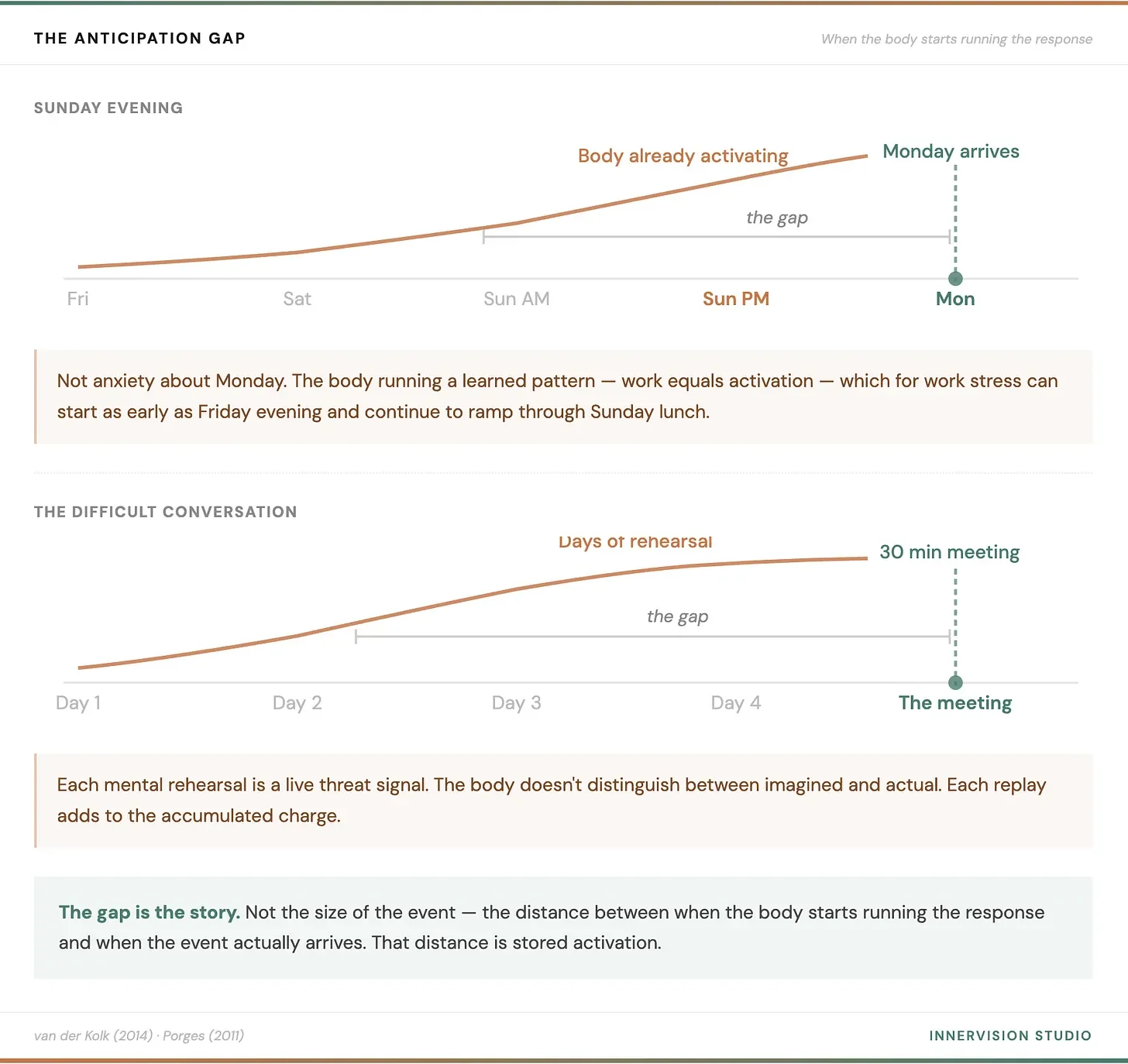
The stress associated with work is a pattern the body learned, not a character trait about your relationship with work. The mind registered the stress often enough in that context; the body started anticipating it — tensing before the meeting started, activating before the week began. The mind sends the signal. The body prepares. And then the body sends signals back that confirm it: something is wrong, brace.
Here’s the mechanism underneath that.
The mind and body aren’t separate channels. They’re in constant two-way communication. An activated mind — racing, restless, rehearsing the same scenario — sends activating signals to the body. And it works the other way: a body that isn’t breathing fully, isn’t moving, isn’t being maintained sends signals back to the brain that something isn’t right. Not a loud signal. A background hum of unease without a clear source. [1]
Most people try to manage that signal from the top — thinking through it, reframing it, understanding it better. That’s useful...but the signal isn’t originating at the top. The stress response lives below the level of language, below the level of interpretation. It was already processing a threat before the conscious mind had a chance to form a thought about it.[2] Understanding the pattern doesn’t discharge it. The body still has to complete what it started.
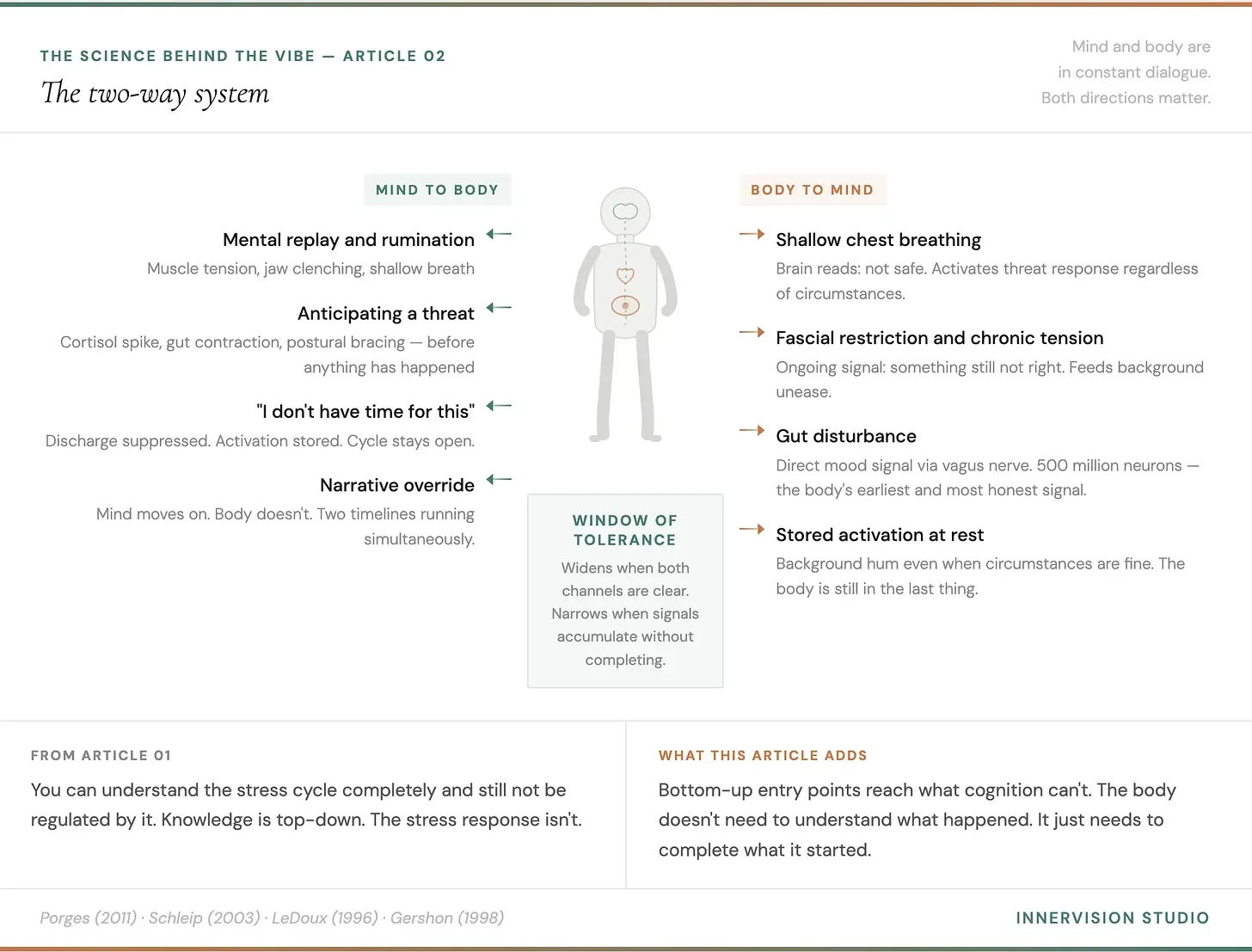
Image Source: Innervision Studio
Back to those two people leaving for vacation. The one who came back reset wasn’t luckier or less stressed going in. Their system had more range available — more capacity to complete cycles during the break. The external tool worked because the internal infrastructure could receive it.
This matters for how you read the framework below. What functions as temporary relief for one nervous system can be genuinely capacity-building for another, depending on where their window sits. Someone carrying very little internal range might widen it through massage or an extended break, because any cycle completion is better than none. The chart is an illustration, not a prescription. Where a tool lands for you depends on where you are.
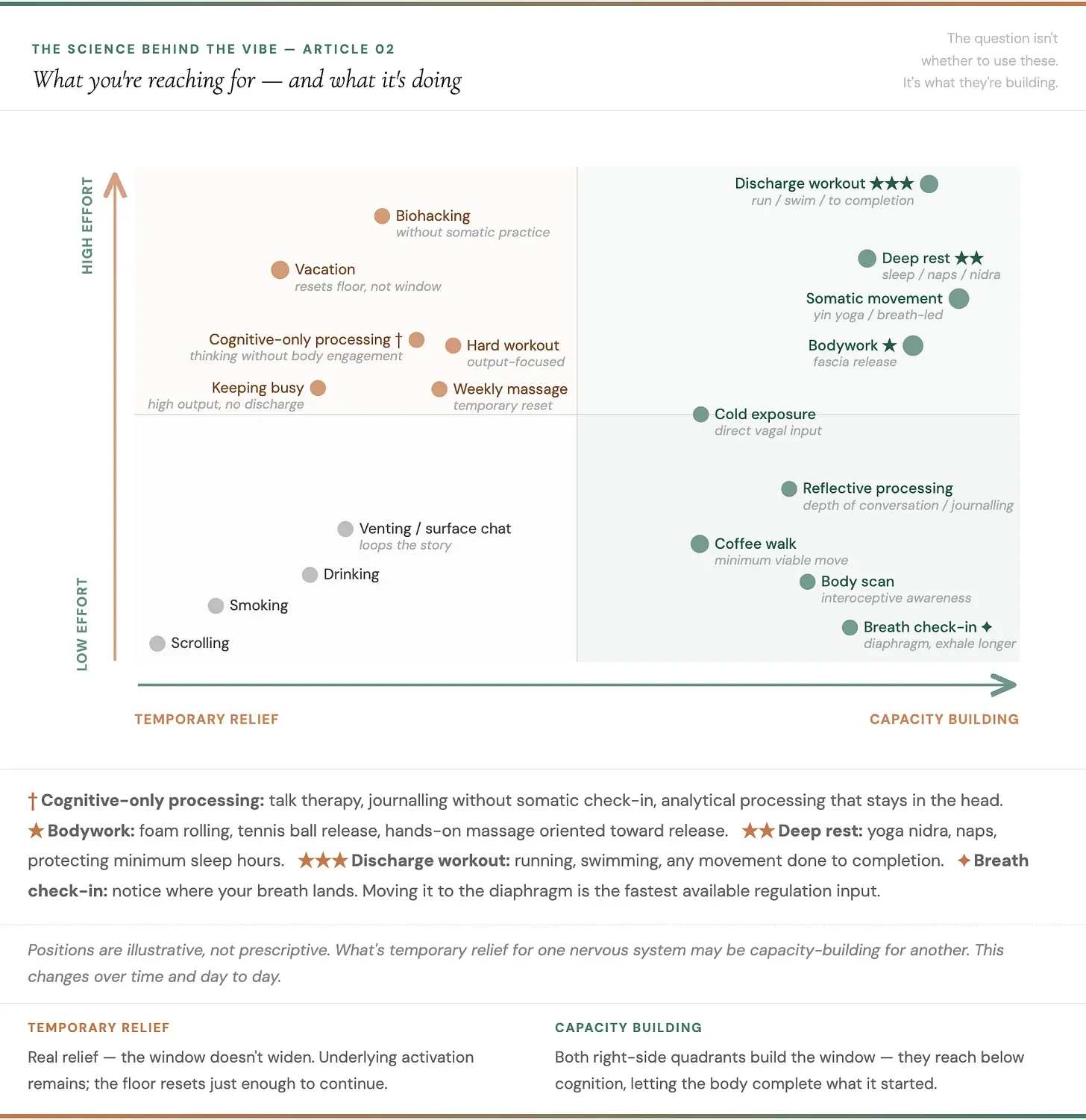
Image Source: Innervision Studio
One thing worth separating on the mind dimension specifically.
Not all stress is the same kind. Some things are unavoidable and just need to get done. But some of the load you’re carrying is self-imposed. Standards you’ve set, commitments you’ve volunteered for, ambitions you’ve told yourself are necessary. The pressure feels external. Look again, and it’s often only you holding yourself to it.
Finding where you have agency in the stress — and being honest about which category each thing belongs to — is its own regulation move. Not everything on the list deserves to be there.
Capacity isn't calm. It's how easily you move through activation without getting fixed in it. Calm is a state. Capacity is the range that determines how long you stay in any state and how much choice you have about it.
How do you know if what you’re reaching for is giving you temporary relief or actually building something? I pay attention to my energy cycle. What activates me, what balances me, what depletes me. As I’ve named those things, reaching for the right one has become instinctive rather than effortful. You don’t have to overhaul the toolkit at once. You just have to start noticing what each thing actually does.
Most high-functioning people have a sophisticated toolkit for relief. What’s often missing is the internal counterpart, the practices that build the infrastructure rather than borrow from somewhere outside it. The understanding is already there; the range is what’s left to build.
If you want to know where your own toolkit sits and what would actually move the needle on your window, that’s worth 15 minutes to look at properly.
References
Porges, S.W. (2003). The Polyvagal Theory: Phylogenetic contributions to social behavior. Physiology and Behavior, 79(3), 503–513.
LeDoux, J.E. (1996). The Emotional Brain: The Mysterious Underpinnings of Emotional Life. Simon and Schuster.
Gershon, M.D. (1998). The Second Brain: The Scientific Basis of Gut Instinct. HarperCollins. — The enteric nervous system, vagal connection, and the gut as an independent signalling centre.
van der Kolk, B. (2014). The Body Keeps the Score: Brain, Mind, and Body in the Healing of Trauma. Viking. — Somatic memory, body patterning, and why stored activation requires bottom-up intervention.